470 Ohm Resistor Color Code — Yellow Violet Brown Gold
470 ohm resistor color code is Yellow-Violet-Brown-Gold (47×10). 4/5-band charts, 5 V LED current, and the 470 Ω vs 4.7 kΩ brown/red trap.
Decode band colors instantly
Full index: All resistor color code values
470 ohm resistor color code (quick answer)
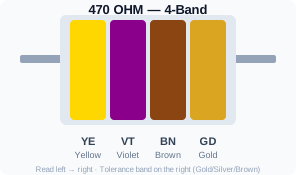
470 ohm resistor color code = Yellow · Violet · Brown · Gold → digits 4 · 7, ×10 → 470 Ω. Yellow and violet are the 47 prefix — same digit pair as 4.7 kΩ (4.7 kΩ guide) but brown vs red multiplier separates 470 Ω from 4700 Ω.
4-band: Yellow · Violet · Brown · Gold → 47 × 10 = 470 Ω (±5%) · 5-band (±1%): Yellow · Violet · Black · Black · Brown → 470 × 1 = 470 Ω (±1%)
Why textbooks used 470 Ω on 5 V (and why kits moved on)
| Era | Typical series R | LED current @ 5 V, $V_f≈2V$ | Philosophy |
|---|---|---|---|
| 1980s–2000s manuals | 470 Ω | ~6 mA | Very safe, dim, long LED life |
| Modern Arduino kits | 330 Ω / 220 Ω | 9–15 mA | Brighter, still within GPIO limits |
470 Ω is not wrong — it is conservative. For a panel indicator where brightness doesn't matter, 470 Ω runs cooler and extends LED life.
Brightness snapshot (5 V, red LED)
| R | Current | Relative brightness |
|---|---|---|
| 220 Ω | ~13 mA | Bright |
| 330 Ω | ~9 mA | Medium |
| 470 Ω | ~6 mA | Dim but clear indoors |
Yellow–Violet digit mnemonic (47 family)
Both 470 Ω and 4.7 kΩ start with 4 · 7:
| Value | 3rd/4th multiplier band | Full 4-band |
|---|---|---|
| 470 Ω | Brown (×10) | Y · V · Brown · Gold |
| 4.7 kΩ | Red (×100) | Y · V · Red · Gold |
This confusion doesn't exist on 220 Ω (both reds) or 1 kΩ (brown-black-red).
TTL-era series termination (historical note)
470 Ω appeared in some 5 V logic application notes as a series damping value. Modern CMOS designs use different rules — treat this as historical context, not a universal recipe.
FAQ
What is the 470 ohm resistor color code?
4-band (±5%): Yellow, Violet, Brown, Gold. 47 × 10 = 470 Ω (±5%). Actual range: 446.5 Ω – 493.5 Ω.
What is the 470 ohm resistor colour code (5-band)?
Yellow · Violet · Black · Black · Brown → 470 × 1 = 470 Ω (±1%). Range: 465.3 Ω – 474.7 Ω.
How do I read a 470 ohm resistor color code?
Read left to right: first bands are digits, then multiplier, then tolerance. For 470 Ω: Yellow-Violet-Brown = significant digits & multiplier, Gold = tolerance. Use the color code calculator to verify.
Which end do I start reading a 470 Ω resistor from?
Start from the grouped digit bands (left). The tolerance band (Gold) is on the right — gold and silver are almost always tolerance, not multipliers.
What is the difference between 4-band and 5-band for 470 Ω?
4-band (Yellow · Violet · Brown · Gold) gives 47 × 10 = 470 Ω (±5%) with typical ±5% gold tolerance. 5-band (Yellow · Violet · Black · Black · Brown) adds a third digit for ±1% precision: 470 × 1 = 470 Ω (±1%) (465.3 Ω – 474.7 Ω).
What is the 5-band 470 ohm colour code?
Yellow-Violet-Black-Black-Brown → 470 × 1 = 470 Ω (±1%).
Is 470 ohm good for Arduino LEDs?
It works but is dimmer than 220–330 Ω; calculate (5−Vf)/R for your target mA.
Related guides (different topics)
- 330 Ω color code — 5 V vs 3.3 V supply matrix
- 220 Ω color code — LED brightness vs 330/470 Ω on 5 V
- 1 kΩ color code — divider math & strong pull-ups
Topic cluster
More resistor color code guides
Learn the method in our beginner's guide · Decode instantly with the color code calculator