10k Ohm Resistor Color Code — Brown Black Orange Gold
10k ohm resistor color code is Brown-Black-Orange-Gold (10×1k). GPIO button pull-ups, NTC dividers, and the orange-vs-red 10 kΩ / 1 kΩ trap.
Decode band colors instantly
Full index: All resistor color code values
10k ohm resistor color code (quick answer)
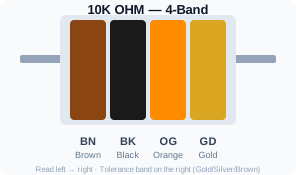
10k ohm resistor color code / 10k resistor color code = Brown · Black · Orange · Gold → $10 × 1000$ = 10 kΩ. Orange is the ×1 k multiplier band — the main reason people misread 10 kΩ as 1 kΩ (red = ×100).
4-band: Brown · Black · Orange · Gold → 10 × 1,000 = 10 kΩ (±5%) · 5-band (±1%): Brown · Black · Black · Red · Brown → 100 × 100 = 10 kΩ (±1%)
This page covers GPIO, buttons, and sensors. For I²C bus engineering, use the 4.7 kΩ I²C guide instead.
Button input with internal pull-up disabled (external 10 kΩ)
Typical UNO/Nano wiring concept:
- One side of switch → GPIO input
- Other side → GND
- 10 kΩ from GPIO → 5 V (or 3.3 V)
When open: GPIO reads HIGH (~5 V). When pressed: GPIO reads LOW. Idle current ≈ $5 V / 10 kΩ = 0.5 mA$ per button — acceptable for bench; use 100 kΩ for battery if speed allows.
NTC / light sensor divider (10 kΩ as top leg)
Many hobby thermistor circuits use 10 kΩ fixed + NTC to mid-scale the ADC:
- Fixed 10 kΩ (Brown-Black-Orange) is the reference leg
- NTC changes $R_{NTC}$ with temperature → midpoint voltage moves
Identify the fixed resistor by color before assuming “all blue-body parts are NTCs.”
Decision: 10 kΩ vs 4.7 kΩ vs 1 kΩ (where to go next)
| Need | Value | Read |
|---|---|---|
| I²C / SMBus SDA,SCL | 4.7 kΩ typical | 4.7 kΩ I²C guide |
| Strong pull, fast edge | 1 kΩ | 1 kΩ divider/pull guide |
| Default GPIO, low idle current | 10 kΩ | (this page) |
| LED on 5 V | 220–330 Ω | 220 Ω LED guide |
Orange vs red multiplier (10 kΩ vs 1 kΩ)
| Multiplier band | Color | Effect on “10” digits |
|---|---|---|
| ×100 | Red | 10 × 100 = 1 kΩ |
| ×1 k | Orange | 10 × 1k = 10 kΩ |
Under poor light, orange can look red — always meter suspicious pull-ups on salvaged boards.
FAQ
What is the 10k ohm resistor color code?
4-band (±5%): Brown, Black, Orange, Gold. 10 × 1,000 = 10 kΩ (±5%). Actual range: 9.5 kΩ – 10.5 kΩ.
What is the 10k ohm resistor colour code (5-band)?
Brown · Black · Black · Red · Brown → 100 × 100 = 10 kΩ (±1%). Range: 9.9 kΩ – 10.1 kΩ.
How do I read a 10k ohm resistor color code?
Read left to right: first bands are digits, then multiplier, then tolerance. For 10 kΩ: Brown-Black-Orange = significant digits & multiplier, Gold = tolerance. Use the color code calculator to verify.
Which end do I start reading a 10 kΩ resistor from?
Start from the grouped digit bands (left). The tolerance band (Gold) is on the right — gold and silver are almost always tolerance, not multipliers.
What is the difference between 4-band and 5-band for 10 kΩ?
4-band (Brown · Black · Orange · Gold) gives 10 × 1,000 = 10 kΩ (±5%) with typical ±5% gold tolerance. 5-band (Brown · Black · Black · Red · Brown) adds a third digit for ±1% precision: 100 × 100 = 10 kΩ (±1%) (9.9 kΩ – 10.1 kΩ).
What is the 10k resistor color code?
Brown-Black-Orange-Gold for 4-band ±5% parts (10 × 1000 = 10 kΩ).
Why is 10k so common?
It is a standard E24 value that balances pull-up strength and power draw on 3.3–5 V logic.
Related guides (different topics)
- 4.7 kΩ color code — I²C rise time & bus capacitance
- 1 kΩ color code — divider math & strong pull-ups
- 1 MΩ color code — megohm measurement & op-amp bias
Topic cluster
More resistor color code guides
Learn the method in our beginner's guide · Decode instantly with the color code calculator